
By: Stephanie Reifschneider, PEP Outreach Assistant Have you ever wondered what it might be like to live amongst dinosaurs? Well, contrary to popular belief, prehistoric creatures walk among us! While […]
By: Stephanie Reifschneider, PEP Outreach Assistant
Have you ever wondered what it might be like to live amongst dinosaurs? Well, contrary to popular belief, prehistoric creatures walk among us! While it might not be the traditional T-Rex that you often think of when you think of the word ‘fossil’, horseshoe crabs have roamed the ocean and its coastlines for 450 million years. This makes them one of the oldest living species on Earth and even older than the dinosaurs themselves!
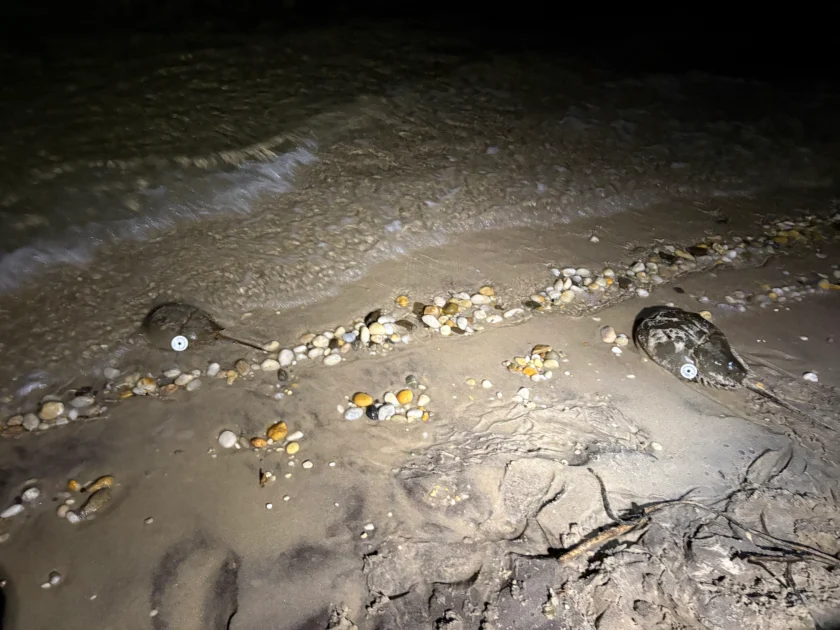
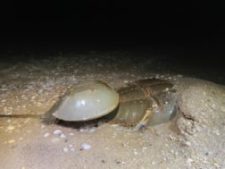
Lately, I have been spending a lot of time with these prehistoric critters, typically in the middle of the night. In the past two months, during spring tides, you can find me walking the shoreline counting, observing, and tagging horseshoe crabs as they spawn as a part of the New York Horseshoe Crab Monitoring. While they are not much for conversation, they’ve been interesting company. As a result, I have had plenty of time to reflect on them. I continuously find myself in awe of these creatures whenever I see them. For animals that seem so simple, it is mind boggling that they have been around for so long.
Horseshoe crabs live by the mantra: ‘If it isn’t broken, don’t fix it!’ The horseshoe crabs we see today are mostly the same in shape and structure to those horseshoe crabs that roamed the Earth at the same time as traditional dinosaurs. This has resulted in horseshoe crabs having the nickname ‘the living fossils’ as they have not evolved much at all. Evolution exists because environmental pressures are put on a given species to adapt or change biological and physical components about themselves in order to survive. However, there has simply not been enough environmental pressure on them to change in any significant way. No pressure means no evolution, and it seems to have worked out pretty well for them. After all, these tough little guys have survived several mass extinction events. In events when 75 – 90% of all living species on Earth disappeared (including plant species), the horseshoe crab has stayed strong! It is incomprehensible to think about how much Earth has changed since horseshoe crabs first stepped on the scene.
Yet, there is a new pressure that horseshoe crabs are woefully unprepared for. In spite of the millions of years of existence, modern human threats are causing significant population declines. In New York State, horseshoe crabs are primarily harvested for bait in commercial eel and whelk fishing, because their oily, tough meat will break down slowly in the water, attracting whelk who are hunting for dead or decaying animals on the seafloor. In other states, horseshoe crabs are harvested for the pharmaceutical industry, as their blood contains special properties to remove bacteria from human vaccinations. While illegal in the state of New York, biomedical harvesting has still doubled in the past decade around the United States. Regardless of the reasoning though, overharvesting of these animals has caused their population to plummet in the past years. Just in New York State, horseshoe crabs have experienced a 70% population decline.
Additionally, critical horseshoe crab habitat loss has occurred due to coastal inundation and hardening of shorelines through bulkheads and seawall from increased human development. With 20% of the Peconic Estuary shoreline being hardened, this displaces critical, coastal habitat, diminishing physical and biological functions of the environment as well as leaving horseshoe crabs’ spawning habitat becoming increasingly limited. For a population that is already threatened due to overharvesting, they need all the help they can get and this is certainly not doing them any favors.
There have been several nights, wherein the conditions seem pristine for horseshoe crabs to make the journey to their breeding grounds to lay their eggs and spawn, and yet the beach remains empty. There is not a horseshoe crab to be seen. How could this happen? Upon speaking with various volunteers and members of the Squires Pond community during my nightly jaunts, I have learned that this has not always been the case. In fact, this area in the Peconic Estuary used to see a much higher population of horseshoe crabs until the start of this century. Even records from the 20th century indicate several periods during the breeding season in which hundreds of horseshoe crabs could be observed on the beaches in the Peconic Estuary with the naked eye. Personally, this is a sobering reality check of how much the population has dwindled in the past decades. Millions of years of history exist within just a singular horseshoe crab and if we are not careful, they can become another piece of the past. It puts into perspective that there is much that needs to be changed in order to give these horseshoe crabs–and by extension the whole coastal ecosystem–a better, fighting chance if they are to continue to exist and thrive for another 400 million years.
Thankfully, we can remain optimistic! In recent years, horseshoe crabs have been officially listed as a ‘keystone species’, demonstrating their significance. This connotation after numerous have revealed that entire coastal ecosystems have evolved around the horseshoe crab’s breeding season; without them, the entire system would collapse. If horseshoe crabs were to disappear entirely from an ecosystem, several other species would be greatly impacted and can even disappear themselves, including species of sea turtles, fish, and sea birds. In short, the more horseshoe crabs that are present in a given area demonstrates how healthy the surrounding ecosystem is. In response to this importance, several monitoring and surveying efforts have been implemented throughout New York State to aid in protecting the horseshoe crab. Such is the case with the New York State Horseshoe Crab Monitoring Network, which has demonstrated to me that there is hope for these resilient creatures to rebound. The nights I have assisted in collecting data as well as administering tags have made me feel incredibly fortunate in contributing towards efforts to conserve these crabs for generations to come. I know that our data is going to be reviewed. I know our data is going to be utilized towards assessing the population status of horseshoe crabs and contributing towards future conservation management plans. When I came across nearly 70 horseshoe crabs skirting around the surf zone in a singular night, I was ecstatic! It was nights like this that gave me immense hope that the fate of horseshoe crabs can turn around from what their current trends are. If there were this many crabs at this little beach in Hampton Bays, imagine how many other crabs are present at all the other sites around Long Island. And imagine the eggs! A singular horseshoe crab can lay up to 4,000 eggs in a singular night, and anywhere from 80,000 to 100,000 in an entire spawning season, laying as many eggs as possible to increase the odds of their young surviving and replenishing the horseshoe crab population for future generations. Talk about a hardworking horseshoe crab mother!
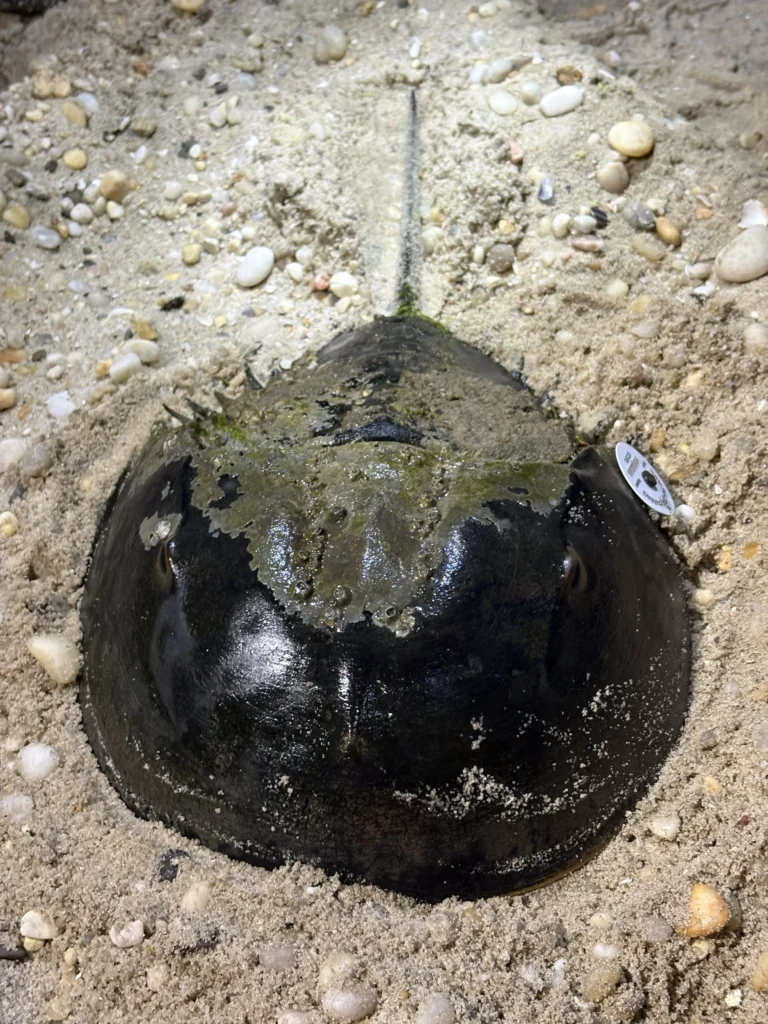
There are many modern solutions that can be implemented to safeguard the horseshoe crab and good news is on the horizon! Here at PEP, we are prioritizing the protection of natural shorelines and healthy estuary ecosystems to help maintain biological and physical functions, reduce erosion, as well as promote resiliency and biodiversity. Through analysis, monitoring trends, and creating resources to restore already occurring natural shorelines as well as implementing further nature-based solutions, we are actively working to conserve horseshoe crabs’ critical habitats, and thus, helping to ensure that their population remains for years to come.
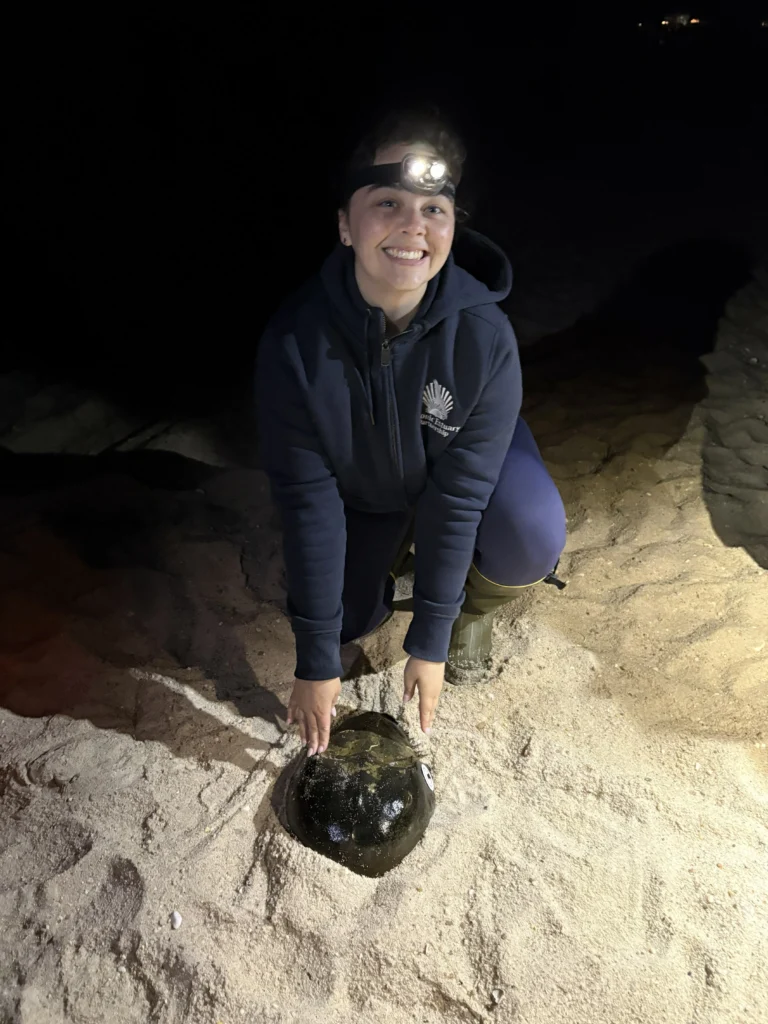
As someone who has always been passionate about marine conservation, I have always felt an affinity towards vulnerable ocean life in various ways. It’s why I decided to pursue a career in marine science and why I continue to do the work I do. Seeing a creature that is technically so simple but possesses such a grand history working hard to replenish their population day in and day out can really reinstate a passion for conservation and love for the coastal environment. Clearly, horseshoe crabs have left a huge impression on me in just the past couple of months and I have seen it leave similar impressions on other volunteers through the New York Horseshoe Crab Monitoring Network. How lucky are we to wake up in the middle of the night and contribute towards scientific studies to save such an important, underappreciated marine animal? I encourage everyone to participate in this incredible citizen science work next spring if you have the time. After all, it is typically only through science fiction where we can imagine a world in which dinosaurs walk among us. In reality, there are dinosaurs scurrying right under us in the ocean and we might not even notice! The conservation actions to help horseshoe crabs will take all of us. For as much as this species has persisted, they deserve to be here. It is unfair to them that human impacts are hindering their ability to exist for another hundreds of millions of years. While challenges lie ahead, my time spent with the horseshoe crabs emphasizes that modern solutions can help to reverse modern problems and that it is imperative to safeguard these ‘dinosaurs’ for millions of more years.
If you are interested in learning more about horseshoe crabs, how to get involved with the New York Horseshoe Crab Monitoring Network, or some of the conservation efforts that are being implemented to prevent further horseshoe crab decline, PEP is hosting a talk at UberGeek Brewery in Riverhead on August 20th and everyone is welcome to attend! Details will be provided on our social media closer to the event and on our website’s Calendar. For more information on horseshoe crabs and the efforts that Peconic Estuary Partnership is contributing towards saving our favorite living fossils, visit our Resilient Communities website or our Ongoing Monitoring Efforts webpage.