
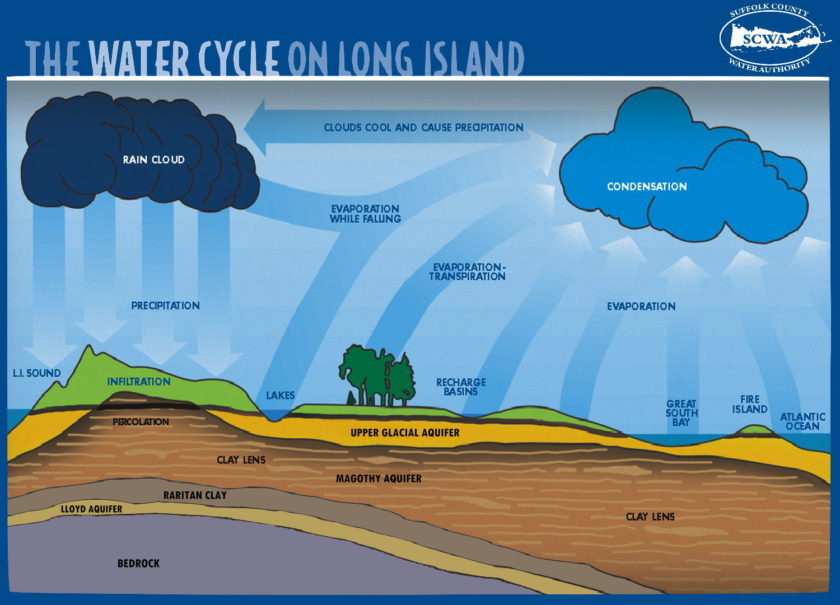
Aquifers are large storehouses of water below ground. Long Island’s main source of drinking water is from groundwater held within an aquifer, making Long Island’s aquifer a ‘Sole Source’ aquifer. As precipitation from the water cycle in the form of rain and snow slowly sinks down through the ground, this water accumulates. Since the water cycle is constantly occurring throughout the Earth, the aquifer is being constantly replenished.
This creates the water table, the upper zone of surface saturation, and the aquifer, the saturated zone all beneath the water table.
Long Island’s aquifer is made up of four primary formations, or more commonly known as layers. These are characterized by their size and age of the water they contain.
Long Island faces threats to the aquifer and groundwater supply from increased development. The amount of water that recharges the aquifer has decreased as a result of increased impermeable surfaces and sanitation systems that discharge into surface waters, instead of re-entering the groundwater. The U.S. Geological Survey provides additional information on Long Island’s aquifer, including the depth to groundwater across Long Island and State of the Aquifer report.
Sign up for News, Events and Information straight to your inbox.
